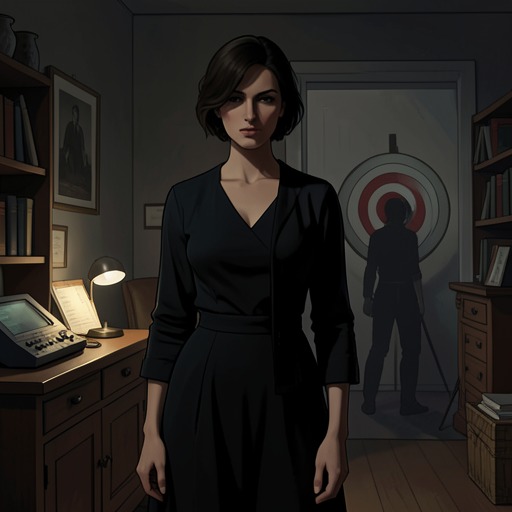
Marco Racin
Mr. & Mrs. SmithMarco Racin is an arms dealer and Jane Smith’s client, but the apparent erotic encounter between them is a cover for an assassination. Jane plays to his expectations long enough to control the room, then turns their role-play into an accusation about his weapons sales and kills him. His death is rendered in the same brisk, unsentimental register as Jane’s next concern: she checks the time and remembers that she is expected at dinner.
Identity and Introduction
Jane describes Marco as a slippery, worn-looking European in his fifties, with a small paunch. Her private appraisal is contemptuous, while her face performs welcome: she presents herself as eager to please because she has been paid. The split between her judgment and her expression establishes the encounter as an act from the outset, with Marco responding to the persona rather than to Jane’s actual purpose.
He approaches slowly, admiring what he believes he has bought. Jane lets him look, hoping his excitement will make him easier to handle, then locks the door. The detail makes the room’s changing function clear: it begins as a staged private meeting, but Jane’s control of the entrance turns it into a contained space for the operation.
The Encounter as a Trap
Marco rummages through the bag Jane has left on the bed. She asks whether it contains anything to his taste; a clasp clicks, her coat falls, and a black rubber dominatrix outfit is revealed. Marco responds with eager approval and pulls her into his sweaty arms, whispering something the narration declines to record. The omitted words keep the scene within Jane’s controlled performance rather than giving Marco’s desire an independent voice.
Jane answers that a person could still go to prison for that sort of thing. Marco replies that this is not true where he comes from. Later, as the scene continues, Jane calls him a bad boy and asks whether he has broken international law. His eyes widen, and a bead of sweat runs down his nose. The questions expose the real subject beneath the sexual staging: Jane is testing and confronting him over criminal conduct, not negotiating intimacy.
Accusation and Death
Jane escalates the interrogation by asking whether Marco has sold big weapons to bad people. At that accusation, his body visibly slackens. He tries to call his bodyguards, but the rubber ball in his mouth prevents him from doing so. Jane pulls his flushed face back, presses her hands against his jaws, and efficiently twists his head without warning.
Marco’s eyes bulge and the ball flies from his mouth. The narration marks the end of the time in which he played with other people’s lives. His death thus answers the charge against him with immediate finality, while the contrast between his helpless attempt to summon protection and Jane’s precise action underscores how thoroughly she has controlled the encounter.
Aftermath and Narrative Role
As Marco’s body collapses onto the bed, Jane takes her mobile phone from her coat to check the time. It is already half past eight. She curses and remembers the Colemans; John would be angry if she failed to show up. A cautious knock follows from one of Marco’s bodyguards, nervous about interrupting the pleasure inside. The knock arrives after the killing, preserving the gap between what the bodyguard believes is happening and what has happened in the room.
Jane later says that she and her colleagues recorded their assignments whenever possible, but that she had deliberately forgotten to have her night with Marco Racin recorded: some memories did not need to be preserved for posterity. While reviewing footage from a botched mission, she watches it in slow motion and examines every part of the screen, then zooms in on her buggy driver’s recording. That work habit illuminates the exception: Jane usually treats visible details as potentially useful intelligence, yet she keeps this encounter outside the archive. Marco’s death is therefore both a completed operation and a deliberately unrecorded episode in her professional life.
Accusation and Death
Jane escalates the interrogation by asking whether Marco has sold big weapons to bad people. At the accusation, his body visibly slackens. He tries to call his bodyguards, but the rubber ball in his mouth prevents him from doing so. Jane pulls his flushed face back, presses her hands against his jaws, and efficiently twists his head without warning.
Marco’s eyes bulge and the ball flies from his mouth. The narration marks the end of the time in which he played with other people’s lives. His death answers the charge against him with immediate finality, while the contrast between his helpless attempt to summon protection and Jane’s precise action underscores how thoroughly she has controlled the encounter.
Aftermath and Narrative Role
As Marco Racin’s body collapses onto the bed, Jane takes her mobile phone from her coat to check the time. It is already half past eight. She curses and remembers the Colemans; John would be angry if she failed to show up. A cautious knock follows from one of Marco’s bodyguards, nervous about interrupting the pleasure inside. The knock arrives after the killing, preserving the gap between what the bodyguard believes is happening and what has already happened in the room.
Jane later explains that she and her colleagues recorded their assignments whenever possible, since even an apparently incidental visible detail might prove important. But she had deliberately forgotten to have her night with Marco recorded: some memories did not need to be preserved for posterity. While reviewing footage from a botched mission, she watches it in slow motion, examines every part of the screen, and zooms in on her buggy driver’s recording. That routine clarifies the exception. Jane usually treats recorded images as potential intelligence, yet she keeps the encounter with Marco outside the archive. His death is both a completed operation and a deliberately unrecorded episode in her professional life.
An Exception to the Record
Jane later explains that she and her colleagues recorded their assignments whenever possible because an apparently incidental detail could become important intelligence. Yet she had deliberately omitted her night with Marco Racin from the recordings: some memories, she says, did not need preserving for posterity. The omission acquires weight beside her methodical review of footage from a botched mission. She slows the recording, inspects every part of the screen, and zooms in on her buggy driver’s view, searching for what she may have missed. Marco’s encounter stands apart from that habit of turning experience into evidence: his death completes the operation, but Jane keeps the episode outside the archive.